Project Overview
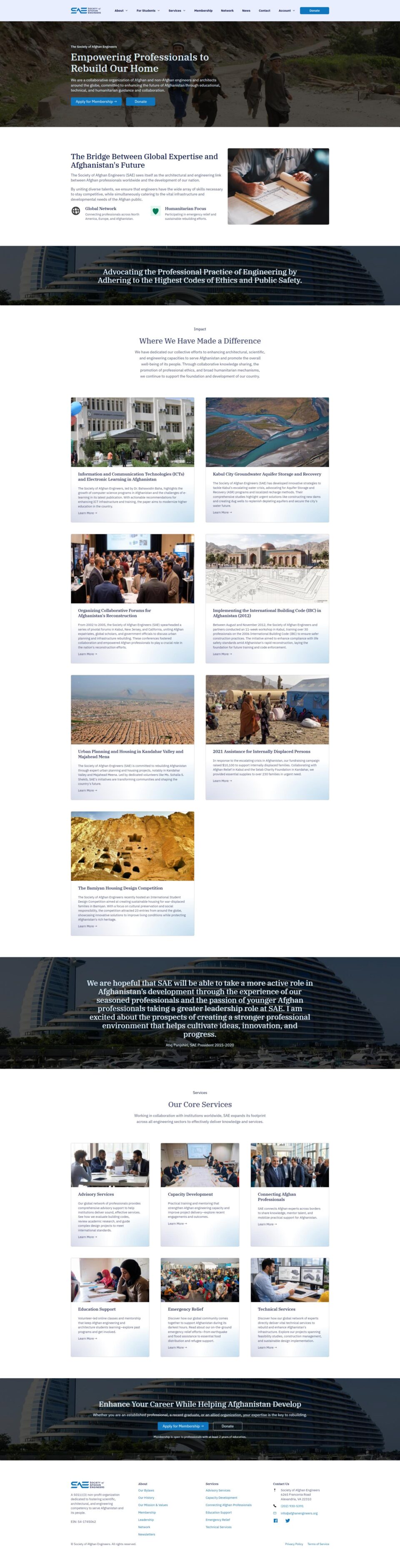
AICyberHelp recently rebuilt the website and additional infrastructure for the Society of Afghan Engineers (SAE). SAE is a US-based 501(c)(3) non-profit global professional network formed in 1993. Its membership consists of engineers from all disciplines, and predominantly engineers of Afghan origin. The main goal of this project was to rebuild their website and related infrastructure to better support their operations in fulfilling their mission, which focuses on rebuilding Afghanistan and expanding technical capacities for Afghan engineers and students.
Limitations of SAE’s Previous Website and Related Infrastructure
From a technical perspective, SAE’s previous website faced several operational limits. While it was built on the WordPress Content Management System (CMS), it was nevertheless designed using limited tooling and unscalable resources. Therefore, the site administration lacked the ability to make the best use of it. In addition, the site was hosted on poor infrastructure, donations and membership dues had to be collected manually, content updates required technical support, and no search engine optimizations were performed.
From a communications perspective, despite SAE having had a strong record of success, their original website did not clearly communicate this. It consisted of approximately 7 pages in total containing mixed content, and while it communicated its overarching points sufficiently, it otherwise contained ambiguous text content and images that did not accurately represent them. Additionally, while SAE itself consisted of highly-credentialed, impactful individuals, as well as a rich history of successful activity, the design and content of their previous website failed to showcase this. Finally, SAE’s internal communications between its executive, board, and members took place via personal Gmail email addresses rather than domain email addresses, further limiting its ability to operate with professional recognition.
Our Objective
We aimed to provide clear and well-thought-out messaging, automate administration, secure member data, create interactive tools, and provide a simple way for SAE to communicate the full scale and success of its mission to members, prospective members, the public, and other organizations. This would allow the organization to better focus on its core initiatives while also appealing to others as a valuable resource and minimizing administrative overhead.
Project Results
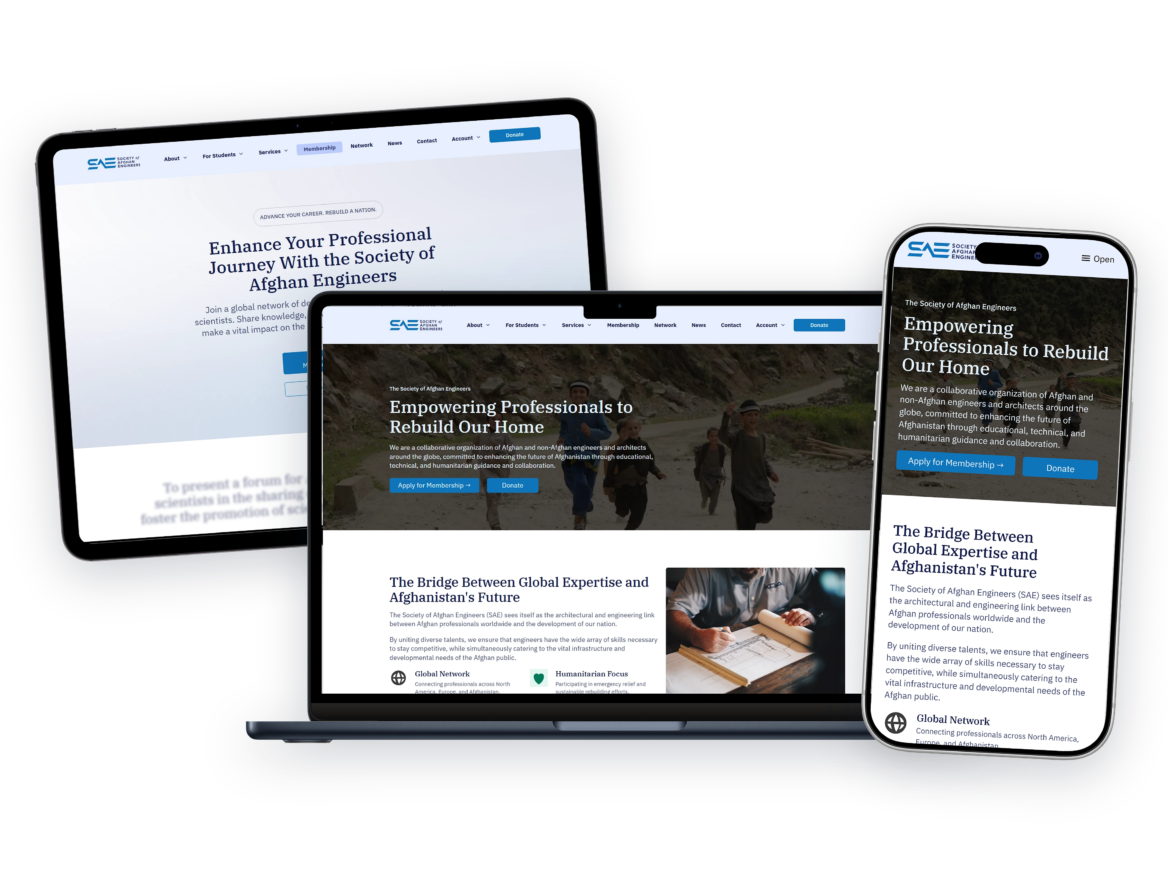
We performed a custom scalable rebuild of their site from scratch, including a custom web platform utilizing WordPress. We used sophisticated tooling to ensure that the system incorporated several critical components and integrations:
- Payment Gateway Integration: We integrated Stripe to handle credit card transactions securely. The system processes online payments of dues and standalone donations.
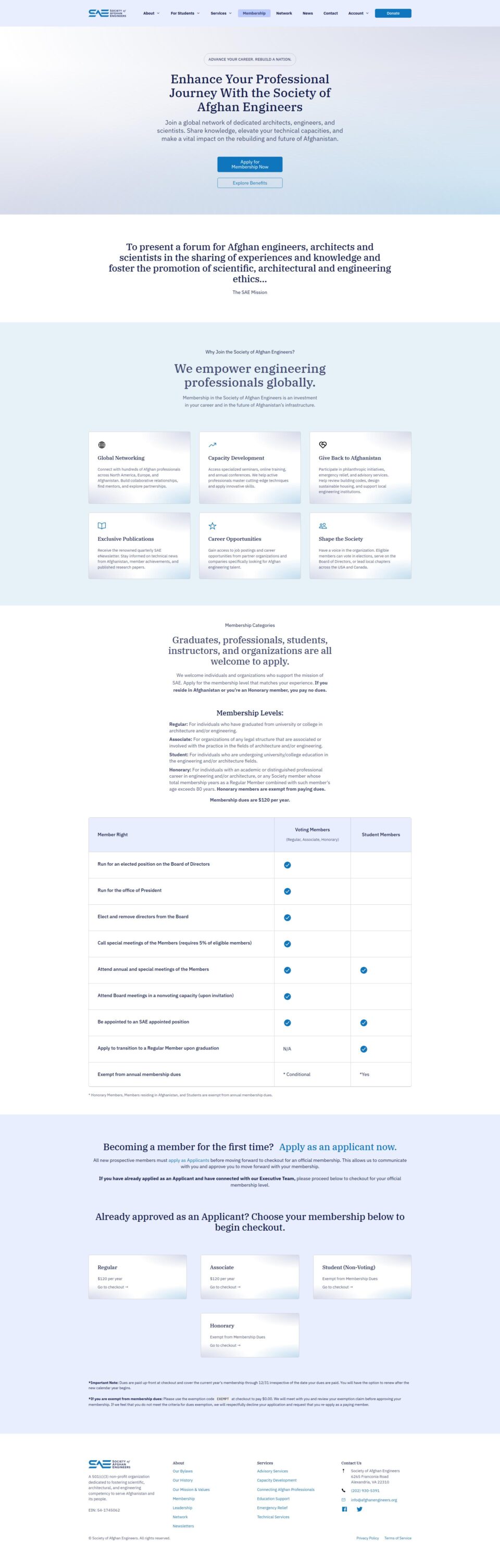
- Multilevel Membership Portal: We created registration levels for different tiers of members. We added custom features to exempt students, honorary members, and members residing in Afghanistan from annual dues per our client’s specifications.
- Educational Support and Scholarship Portals: We created dedicated informational pages for the Ashraf Roshan Scholarship for Architecture Education, an annual scholarship awarded to students attending Kabul University’s Faculty of Engineering program.
- Siloed Service Pages: We designed separate, dedicated sections for each of SAE’s core services. These services include advisory, capacity expansion, networking, educational support, humanitarian aid, and technical services.
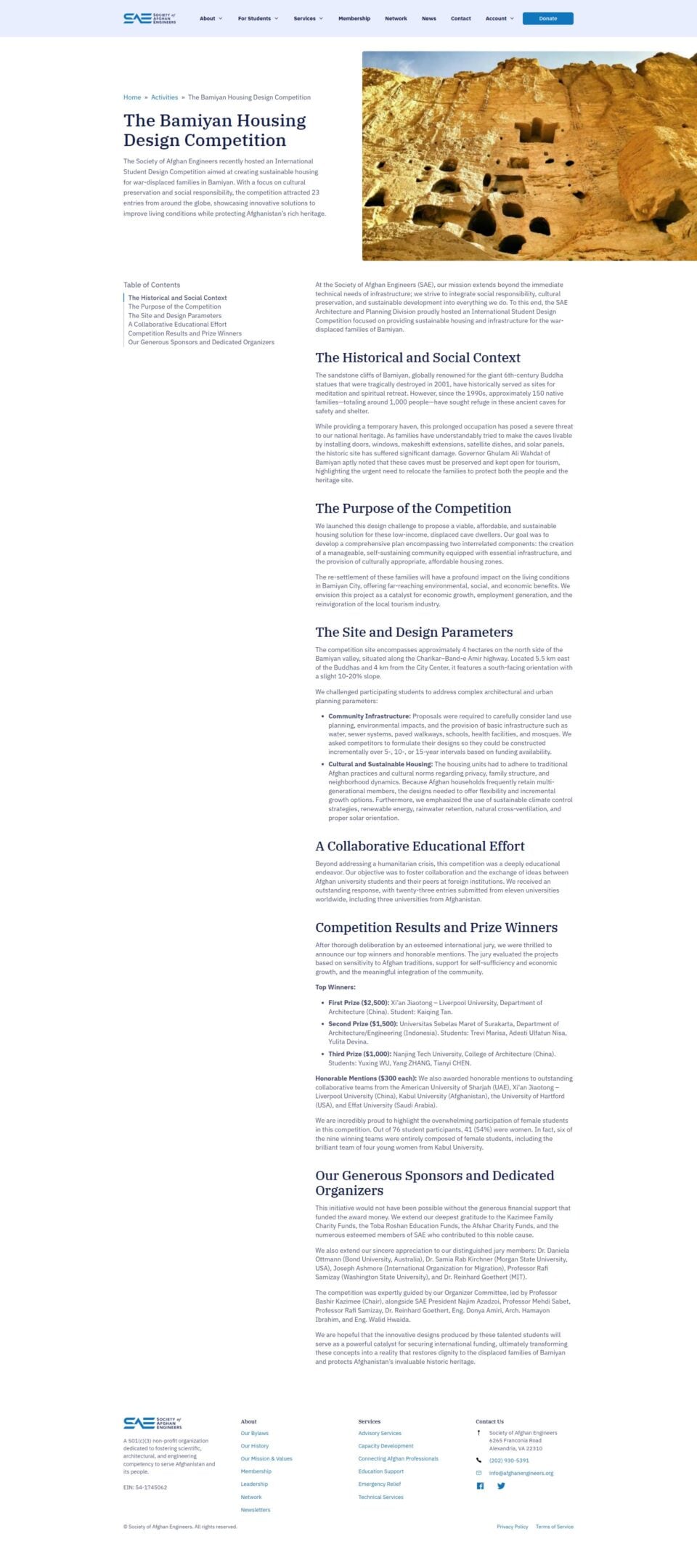
- Activity Pages: Within each service, we designed content pages to highlight specific activities in detail. At launch, this amounted to 31 detailed activities that SAE has engaged in over time to further their mission.
- Migrated Archives: We successfully migrated 56 quarterly newsletters from SAE’s previous site to preserve the organization’s legacy. We also successfully converted them all from print-ready PDF format to native HTML format for easier ingestion by search engines and users. Still, we attached the organization’s original PDF newsletters to each post to allow for users to download them in their original form if desired.
- Membership Access Control: We designed an approval queue on the admin dashboard. When a new user applies, their status is set to pending. The system alerts the treasurer via an automated email containing the applicant’s details. This then gives the executive team the chance to evaluate the applicant for membership before allowing the applicant to checkout under a given membership tier.
- Physical Membership Card Utility: We built a utility in the member dashboard that renders physical membership cards in three different sizes. It displays the member’s details, membership level, and renewal status.
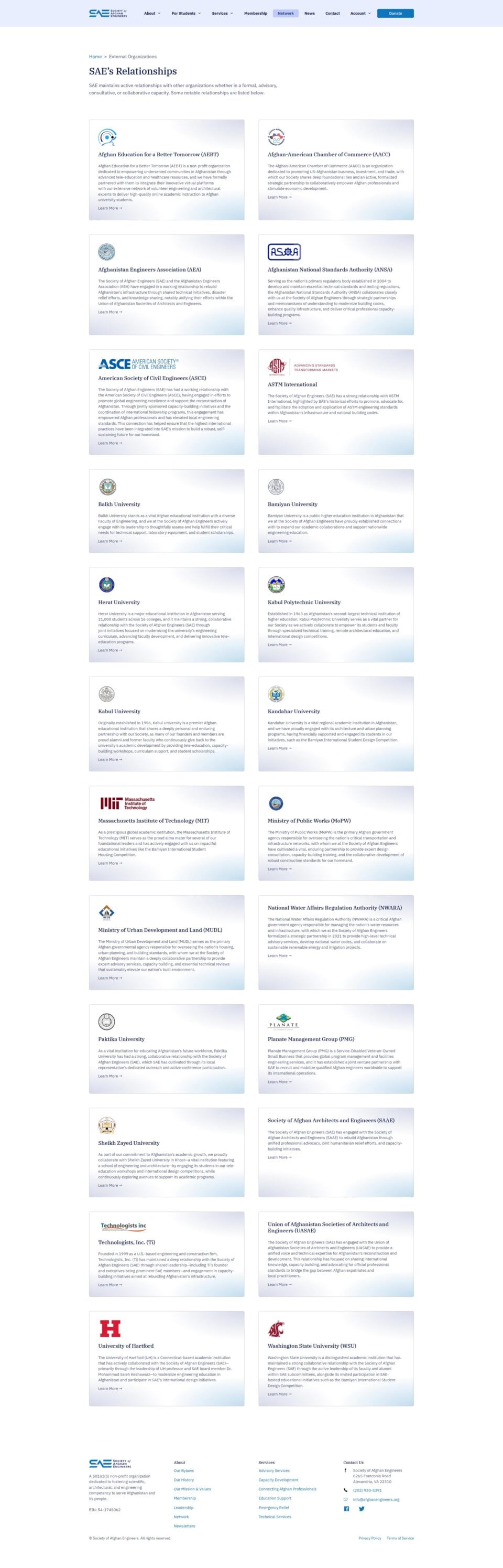
- Partner Network: We built a directory of SAE’s extensive network of partner and collaborative organizations.
- Security Infrastructure: We routed the website through Cloudflare to help protect the system against malicious bots, automated scripts, and spam submissions.
- Secure User Accounts: Logged-in members can access a private dashboard to change passwords, edit an intentionally limited set profile information, and access their Stripe billing history.
- Domain-Based Email Addresses: We secured Google’s recognition of SAE as a legitimate non-profit entity, allowing SAE to benefit from a generous free tier of Google Workspace that includes @afghanengineers.org email addresses, virtual conferencing via Google Meet, and a separate low-cost Google Voice subscription for incoming and outgoing calls.
- Email Server: We provided a year of transaction email service to the website itself for membership expiration reminders, password resets, membership approvals and denials, new checkouts, etc.
Conclusion
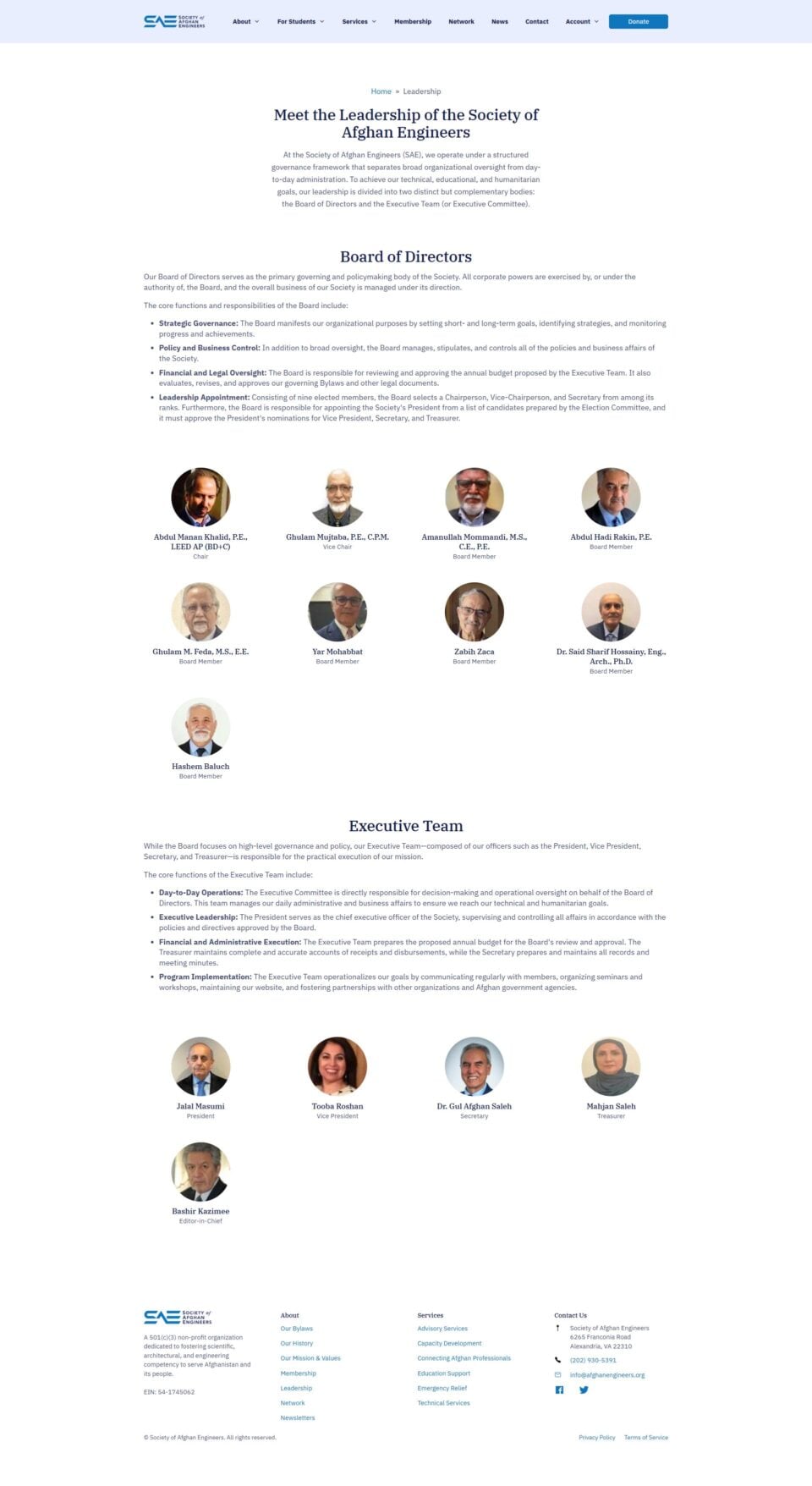
SAE’s website as of September 2026 consists of 139 pages of unique and engaging content across 31 activities, 24 partners, 14 leadership profiles, 56 newsletters, 3 “about” pages, the homepage, and navigational pages. For context, the site is built to scale, so 139 pages is rather small — it can easily scale to hundreds of thousands of pages with negligible maintenance overhead or performance bottlenecks.